
There is a specific kind of exhaustion that comes from watching a child struggle in school while feeling like nothing is actually changing. Another IEP meeting. Another round of accommodations that sound promising on paper. Another school year where the gap quietly widens and the child who used to love learning starts dreading Monday mornings. For families of special needs students, that experience is heartbreakingly common — and far too costly to keep accepting as normal.
Special Education Resource was built for exactly this moment. The mission is to connect students with a qualified special needs tutor who does something most academic support never does: identifies the real reason a child is struggling and fixes it at the source, not the surface.
This article breaks down why learning gaps form in special needs students, what happens when they go unaddressed, and how a targeted, assessment-first approach can change a child’s academic trajectory — and the way they see themselves — for good.
Why Learning Gaps Form in Special Needs Students

Learning gaps are rarely random. For students with learning disabilities, ADHD, autism spectrum disorder, dyslexia, or other developmental differences, gaps almost always trace back to one specific challenge that standard classroom instruction was never designed to address.
Here is a straightforward example. When a student struggles to read words fluently — not because they are not trying, but because their brain processes letters and sounds differently — every subject that involves reading becomes a barrier. Math word problems. Science lab reports. History essays. Social studies textbook chapters. One unresolved reading challenge quietly touches every part of the school day.
The same dynamic plays out differently depending on the student. A child with ADHD who has difficulty holding multiple pieces of information in mind at once — what is often called working memory — can struggle to follow multi-step instructions even when they fully understand the concept being taught. A student on the autism spectrum may have strong academic knowledge in certain areas but face significant challenges with the way information is presented, transitions between tasks, or the sensory environment of a busy classroom. A child with dyslexia may be articulate, curious, and genuinely bright, but fall further and further behind in a reading-heavy curriculum that was not built for how they decode language.
In each case, the gap is not a character flaw or a motivation problem. It is a mismatch between how the student learns and how they are being taught. And until that mismatch is identified and corrected, more classroom time and more homework does not close the gap — it just adds more frustration on top of it.
Most schools are doing the best they can within real constraints. Teachers are stretched across large class sizes, often without the specialized training needed to differentiate instruction effectively for students with complex learning profiles. Even students with a formal IEP in place — a legal document outlining the specific supports a school is required to provide — frequently fall short of the progress those documents promise. Services get delivered inconsistently. Goals are written in vague language that is hard to measure. A child can technically be receiving support and still be falling further behind.
Parents often know something is wrong long before the assessments confirm it. The signs show up at home first: longer and more painful homework sessions, a child who comes home defeated, a student who has stopped raising their hand in class because the risk of being wrong feels too high. That instinct is worth trusting.
What Happens When Learning Gaps Go Unaddressed
Academic gaps in special needs students do not plateau on their own. They compound — and they do so faster than most families expect.
Consider a child who enters second grade without solid phonics skills. Phonics is the foundational ability to connect sounds to letters and letter combinations — the building block of all reading. Without it, sounding out unfamiliar words is unreliable at best. By third grade, when reading shifts from a subject unto itself to the primary vehicle for learning everything else, that phonics gap creates a reading comprehension gap. By fourth and fifth grade, the student is behind in science and social studies because the texts are too hard to access. By middle school, years of academic struggle have taken an emotional toll that shows up as anxiety, refusal to attend school, or complete withdrawal from learning.
This trajectory is not inevitable — but it is common, and it is why early, targeted intervention matters so much. Research on learning disabilities consistently shows that the window for the most efficient catch-up is earlier rather than later. A second grader with a reading gap needs a fraction of the intervention time that a sixth grader with the same gap does, because the sixth grader has also accumulated years of avoidance, reduced reading practice, and eroded confidence that all have to be addressed alongside the academic content.
For parents who are already in the thick of the IEP process, this is a particularly hard reality to sit with. The IEP is supposed to be the safety net. It is supposed to ensure that a child gets what they need. When it is not working — when the meetings keep happening and the goals keep rolling over and the child keeps falling further behind — the frustration is real and it is justified. Advocating within a school system is exhausting work, and many families reach a point where they recognize that waiting for the system to deliver is no longer a plan. Seeking outside support is not giving up on the school. It is choosing to prioritize the child’s momentum.
The Real Problem With Most Academic Support
When families do seek outside tutoring, the most common approach they encounter starts with the curriculum: review what was taught in class, reteach the lesson, assign similar practice problems, repeat. For many students, this works reasonably well. For special needs students, it frequently does not.
The reason is that curriculum-first tutoring treats the symptom. A student who cannot complete math word problems gets more math word problems. A student who struggles to write paragraphs gets more paragraph assignments. The practice accumulates without addressing the underlying reason the skill is not developing — and the student continues to experience failure, just in a different setting.
What actually works for special needs students is identifying and fixing the root cause. That requires a different starting point entirely: the student themselves, not the curriculum.
Special Education Resource takes this approach by design. Before any instruction begins, the work starts with a real assessment — not a placement quiz, but a genuine examination of how the student processes information, where the specific breakdown is occurring, and what kind of instructional approach their brain actually responds to. That assessment drives everything that follows.
An autism tutor working through Special Education Resource, for example, is not just a general tutor who happens to work with students on the spectrum. They bring specialized knowledge of how autism affects learning — including the sensory sensitivities, communication differences, and processing patterns that influence how a student receives and retains information. Sessions are structured to be predictable and low-pressure, built around the student’s strengths, and designed to produce the kind of consistent, repeatable success that builds real momentum.
This is the difference between support that feels good in the moment and support that actually moves the needle.
Signs a Student Needs Catch-Up Support Now
These are the patterns worth paying close attention to. Even one or two of them, showing up consistently over time, is a signal that targeted intervention should be a priority sooner rather than later:
- Performing significantly below grade level despite having an IEP and receiving services at school — if the current support is not closing the gap, something about the approach needs to change
- Homework battles that feel completely out of proportion to the actual difficulty of the assignment — when a 20-minute task takes two hours and ends in tears, that is not a discipline problem, it is a signal that the underlying skill is missing
- A child who used to try and has stopped — avoidance is almost always a sign that failure feels like a guaranteed outcome, and no child willingly walks toward that feeling
- Teacher feedback that the student works hard but cannot retain material from day to day — inconsistent retention often points to a processing gap that effort alone cannot bridge
If these feel familiar, the gap is already there. The only question is how much wider it gets before it is addressed directly.
Flexible, Scalable Support — For Families and Districts Alike
One of the most frustrating realities in special education is that the families who need specialized support the most are often the ones with the least access to it. High-quality, specialized tutoring has historically been expensive, geographically limited, and dependent on knowing where to look. For school districts trying to provide equitable support across hundreds or thousands of students with diverse learning needs, finding a partner who can actually deliver has felt nearly impossible.
Special Education Resource was built to solve both problems at once.
The service model is designed to scale without sacrificing the individualization that makes it effective. Individual families can access one-on-one tutoring tailored specifically to their child’s profile. Homeschool groups and small learning communities can access group support that maintains that same targeted, assessment-driven approach. School districts and state programs can partner with Special Education Resource for broad, consistent, districtwide support — delivered by specialists who understand compliance, IEP alignment, and the complexity of serving diverse student populations.
The flexibility is not incidental. It reflects a core belief that access to effective special education support should not be determined by a family’s zip code or income level, and that districts deserve a partner capable of meeting them at scale without asking students to fit a one-size model.
Building Confidence Alongside Academics

Academic progress is the measurable outcome. But for special needs students who have spent months or years experiencing school as a place where they consistently come up short, the confidence piece is inseparable from the academic piece — and in many ways, it is the more urgent one.
Chronic academic struggle leaves a mark. Children who have been told — explicitly or implicitly, through grades and test scores and the looks on people’s faces — that they are not keeping up begin to build an identity around that story. They stop raising their hand. They stop trying new things. They develop a deep aversion to risk because risk has always led to failure. By the time a family seeks outside support, there is often as much emotional repair needed as academic remediation.
This is why Special Education Resource’s approach is paced to produce wins, not just push through content. When a student experiences genuine understanding — when something that has been baffling and defeating for years suddenly clicks — it does not just improve their grade on the next quiz. It rewrites the story they have been telling themselves about what they are capable of. That shift from “I am the kid who can’t do this” to “I just needed to be taught differently” is profound. It follows a child into every classroom they walk into for the rest of their lives.
For parents who have watched their child’s sense of self quietly shrink alongside their grades, this is often the outcome that means the most. A better report card matters. A child who walks into school believing they belong there — that they are capable, not broken — is everything.
What to Expect From a Special Education Resource Partnership
Families and organizations working with Special Education Resource can expect a clear, intentional process from the very beginning:
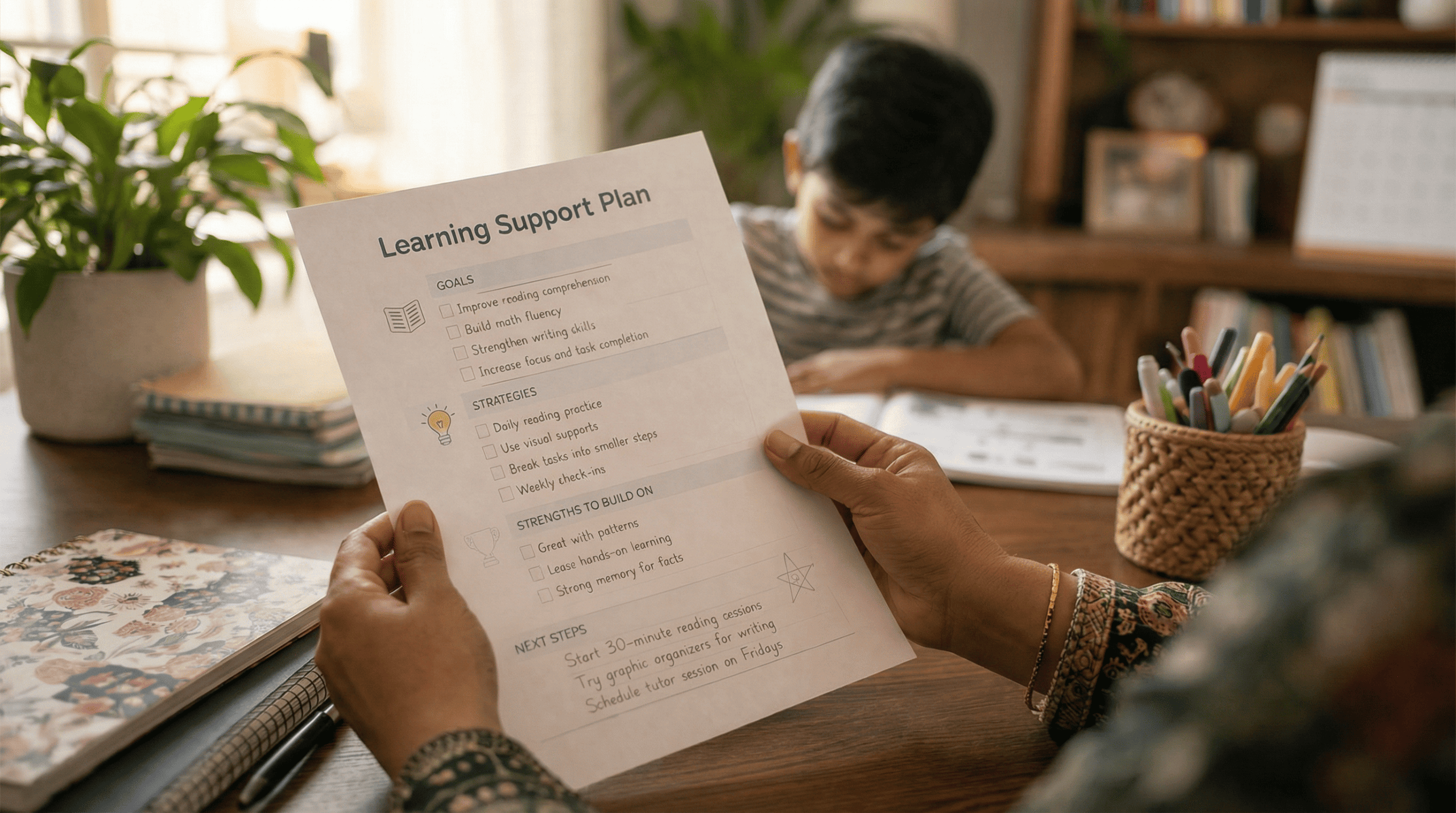
- An initial assessment that identifies the specific learning roadblocks standing between the student and real progress — not a guess, a diagnosis of the actual challenge
- A targeted instructional plan built around that student’s unique profile, aligned with IEP goals where applicable so school and outside support are working in the same direction
- Ongoing progress tracking that gives parents and educators concrete data on what is improving and what still needs attention
- Consistent communication that keeps families informed and involved without adding to an already full plate
- Sessions paced to build genuine mastery, not just move through material
The team works across a wide range of learning differences and grade levels — from early elementary students just beginning to show signs of academic difficulty, to older students whose foundational gaps were never caught and have been quietly compounding for years. It is never too early to act, and it is never too late to start.
The Right Time to Act Is Before the Gap Gets Bigger
Here is what experience and research both confirm: the longer a learning gap goes unaddressed, the harder it becomes to close. Not impossible — but harder, slower, and more emotionally expensive for the student.
A child who is one grade level behind has a clear, achievable path to catching up with the right support. A child who is three or four years behind faces a steeper climb — and carries the accumulated weight of years of struggle that make every step of that climb harder.
For parents who have been watching and waiting, hoping things will improve on their own: that instinct comes from love. But learning gaps do not close with time alone. They close with targeted, expert instruction delivered consistently by someone who understands exactly what is in the way.
Special needs students are not behind because they cannot learn. They are behind because they have not yet had access to the kind of teaching that works for how their brains are wired. That is not a permanent condition. It is a solvable problem — and the solution starts with one decision: to stop waiting and start fixing.
To learn more or get started, visit specialedresource.com.