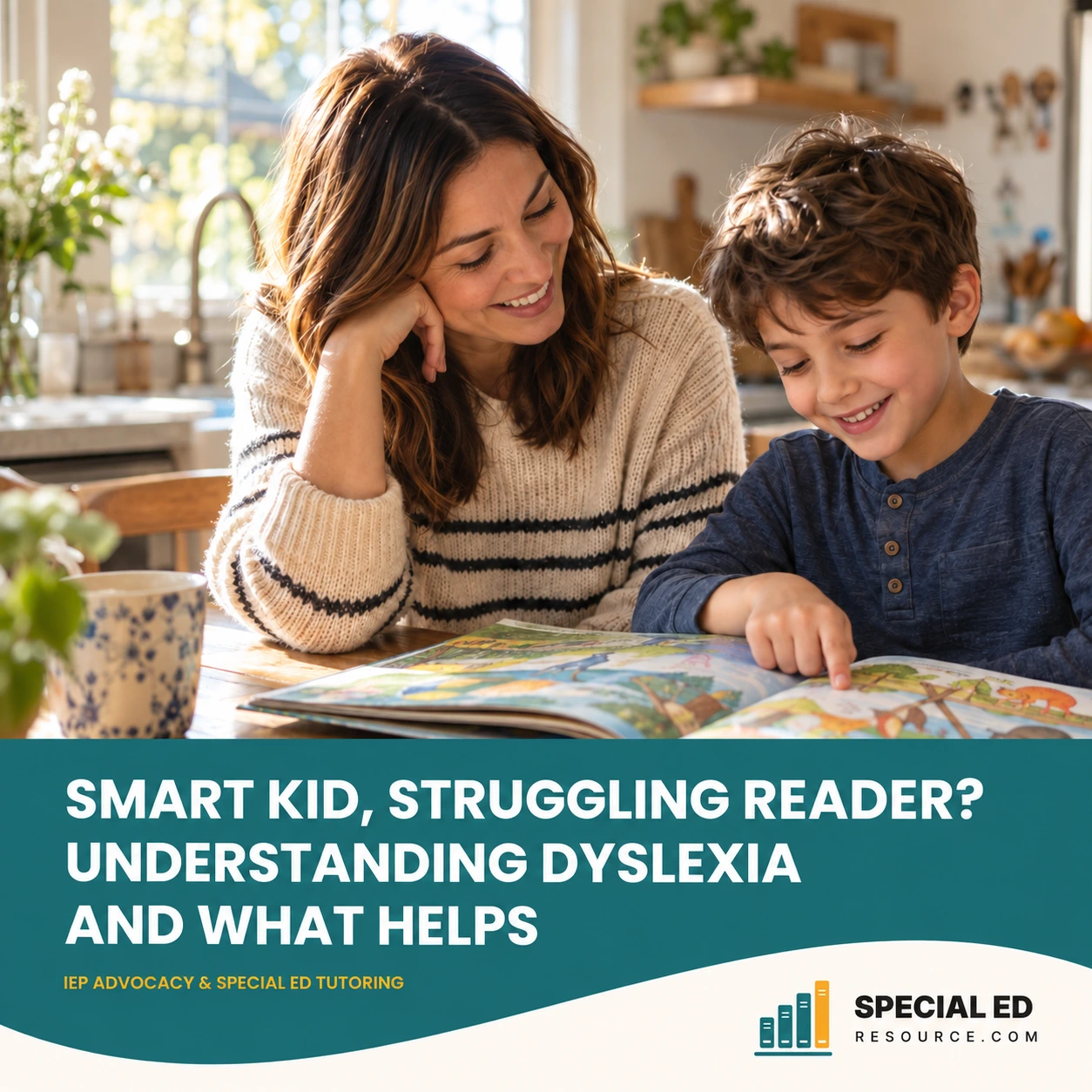
Your child tells great stories, asks sharp questions, and remembers every detail of a trip from two years ago. But put a page of text in front of them, and something changes. Shoulders tighten. Words get guessed instead of read. Homework that should take twenty minutes stretches into an hour of tears, frustration, and "I'm just stupid." If that scene feels familiar, dyslexia may be part of the picture.

Dyslexia is the most common learning disability, and it is also one of the most misunderstood. Many families spend years hearing that a child will "catch up," "just needs to try harder," or "is a late bloomer" before anyone names what is really going on. This guide walks through the early dyslexia signs to watch for at every age, how dyslexia is identified, the myths that keep kids from getting help, and how the right support, including targeted dyslexia tutoring, helps children read with growing skill and confidence.
Why Learning Disabilities Awareness Month Matters for Families
October is Learning Disabilities Awareness Month in the United States and Canada. For families, it can be a useful time to discuss reading concerns with teachers as the school year gets underway. Screening schedules and reporting dates vary by school.
This is often the moment parents notice that a child who seemed fine over the summer is now avoiding reading time, melting down over spelling lists, or bringing home notes about "not following directions" during independent work. Awareness months exist to shift the conversation from "What is wrong with this child?" to "How does this child learn, and what do they need?" That shift matters. Children with reading struggles are not broken, and they are not failing on purpose. They are working with a brain that processes language differently, and they deserve instruction designed for the way they learn.
Raising awareness also helps families feel less alone. Dyslexia is common. Estimates vary depending on how it is defined, but researchers generally agree that it affects a meaningful share of students in every classroom, including many who are never formally identified. Every October conversation brings more of those students into view.

What Dyslexia Is (and What It Is Not)
Dyslexia is a specific learning disability involving persistent difficulty with accurate or fluent word reading and/or spelling. Difficulties with processing speech sounds and meaningful word parts are common, but they are not present in every person with dyslexia. A child may struggle to decode unfamiliar words, read fluently, or spell accurately.
Dyslexia often runs in families. Its causes involve interacting genetic, neurobiological, and environmental influences. It is not a sign of poor parenting or lack of effort, and it is not defined by seeing letters backward.
Reading difficulty does not tell you how intelligent a child is. A child may understand a story read aloud yet struggle to read the words independently. That difference is worth discussing with the school, but it is not a diagnosis by itself.
Dyslexia also exists on a spectrum. Some children experience mild difficulty that shows up mostly in spelling and reading speed. Others struggle significantly with basic decoding well into the upper grades. Dyslexia frequently occurs alongside other learning differences, including ADHD, dysgraphia, and challenges with working memory, which is one reason a thorough evaluation matters.
Early Dyslexia Signs to Watch for at Every Age
Dyslexia signs can appear long before a child is expected to read independently. Spotting them early makes a real difference, because reading intervention works best when it starts young. That said, it is never too late. Older children, teens, and even adults improve with the right instruction.
The signs below are patterns to discuss with a qualified professional, not a checklist for diagnosis. Children develop at different rates. Persistent concerns—or a family history of reading difficulty—are reasons to seek guidance rather than wait for a particular number of signs.

Preschool and early kindergarten:
- Trouble learning letter names and sounds, even with repeated practice
- Difficulty recognizing or producing rhyming words
- Mixing up the order of sounds in longer words, such as "aminal" for "animal," well past the typical age
- Trouble remembering familiar sequences, like the days of the week or the alphabet song
- A close relative who had difficulty learning to read
Kindergarten through second grade:
- Difficulty connecting letters to their sounds and blending sounds into words
- Guessing at words based on the first letter or the picture instead of sounding them out
- Reading that is slow, choppy, and tiring, even for short passages
- Spelling that looks unpredictable or phonetically unusual
- Strong resistance to reading aloud, or complaints of stomachaches before reading time
Third grade and beyond:
- Reading far below grade level despite strong listening comprehension
- Avoiding reading for pleasure and taking much longer than peers to finish assignments
- Persistent spelling errors, including on words that were studied and tested
- Trouble learning a foreign language or remembering new vocabulary from print
- Written work that does not reflect how much the child knows when speaking
Emotional signs deserve attention too. Children with unidentified dyslexia often notice that reading is easier for classmates long before adults name the problem. They may start calling themselves dumb, act out to avoid reading tasks, or quietly shut down. These reactions are not character flaws. They are often a child's way of protecting themselves from repeated frustration.
Common Myths About Dyslexia That Hold Children Back
Myths about dyslexia delay help for countless children. Clearing them away is one of the most valuable things families and educators can do during Learning Disabilities Awareness Month.
Myth: Children with dyslexia are lazy or not trying hard enough. The reality is the opposite. Most children with dyslexia work much harder than their peers to produce the same result. Reading requires so much effort that it drains energy quickly, which can look like avoidance or distraction. When effort is high and progress is still slow, the instruction needs to change, not the child's attitude.
Myth: Dyslexia means low intelligence. Dyslexia is unrelated to intelligence. Children across the full range of intellectual ability can have dyslexia, including many who are academically gifted in other areas. Treating reading struggles as a measure of overall ability does lasting harm to a child's confidence.
Myth: Dyslexia is just seeing letters backward. Letter reversals, such as confusing b and d, are common in all young children as they learn to write. They are not the defining feature of dyslexia. The core difficulty is with sounds and language processing, not with eyesight or mirror images.
Myth: Kids will outgrow it. Dyslexia is lifelong. Children do not outgrow it, but they can learn to read well with explicit, structured instruction. Waiting to see whether a child catches up often means losing valuable time when intervention is most effective.
Myth: Dyslexia cannot be identified until third grade. Many families are told to wait until a child officially falls behind. In reality, early warning signs and risk factors can be identified in preschool and kindergarten through screening, and children can begin receiving targeted support right away.
Myth: More reading practice will fix it. Simply asking a child to read more, without changing how reading is taught, rarely solves the problem. Children with dyslexia need direct, systematic instruction in how sounds and letters work together. Practice helps most when it builds on that foundation.
How Dyslexia Is Diagnosed
Many parents are surprised to learn that dyslexia is identified through a comprehensive educational or psychological evaluation rather than a single test. A qualified professional, such as a licensed psychologist, neuropsychologist, or school psychologist, looks at the full picture of how a child learns.
A comprehensive evaluation typically looks at:
- Phonological awareness: how well a child hears and works with sounds in words
- Decoding and word reading: accuracy with real words and made-up words
- Reading fluency and reading comprehension
- Spelling and written expression
- Rapid naming: how quickly a child can name familiar items like letters, colors, or objects
- Language, developmental, and other relevant abilities, selected according to the child’s needs
- Developmental, family, and educational history
In the United States, parents can request an evaluation from their public school when they suspect a disability. Put the request in writing and keep a dated copy. Eligibility for IDEA services depends on the evaluation and the child’s educational needs. Families may also seek a private evaluation; its cost, scope, and timing depend on the provider.
In Canada, assessment and school-support processes vary by province or territory and school board. Ask the school what assessment options are available, who is qualified to conduct them, and how results will guide support. Ontario, for example, describes educational and professional assessments as part of planning for students’ needs.
Whatever the path, the evaluation report is more than a label. It explains a child's specific strengths and gaps, and it becomes a roadmap for instruction, accommodations, and goals.

Getting the Right Support at School
Once reading needs are identified, the next step is making sure school support matches the evaluation. In the United States, a student who meets IDEA eligibility requirements may receive an Individualized Education Program (IEP). Section 504 can provide accommodations, related aids and services, and, when needed, special education. A dyslexia diagnosis alone does not determine which plan a child needs. In Canada, the name and requirements of a support plan depend on the provincial or territorial system.
Accommodations help a child access learning while reading skills develop. Common examples include extended time on tests, audiobooks and text-to-speech tools, reduced copying from the board, oral testing options, and grading that separates spelling errors from content knowledge.
Accommodations alone are not enough for most children with dyslexia, however. A child who listens to every textbook through audiobooks can keep up with content but still needs direct instruction to build reading skills. Parents should ask what reading intervention the school provides, how often, in what group size, and how progress will be measured. Vague answers, such as "extra reading support" with no named method or data, are worth questioning. Progress should be visible in the numbers, not just in a teacher's general impression.
How Dyslexia Tutoring Builds Reading Skills and Confidence
For many families, school support is a starting point rather than a complete solution. Classroom teachers are managing large groups with wide-ranging needs, and pull-out intervention time is often limited. Targeted, one-on-one instruction fills the gap by giving a child focused practice at exactly the right level.
Effective dyslexia tutoring is built on structured literacy, an approach supported by decades of reading research. Structured literacy teaches the building blocks of language directly and in a logical order, so nothing is left to guesswork. Strong programs share several features:
- Explicit instruction: skills are taught directly, not discovered by chance
- Systematic sequence: each skill builds on the one before it, from simple to complex
- Multisensory practice: children see, hear, say, and write sounds and words to strengthen memory
- Cumulative review: earlier skills are revisited so they stay solid
- Ongoing assessment: lessons adjust based on what the child has mastered and where gaps remain
Just as important as the method is the match between tutor and student. A child who has spent years feeling behind needs a patient, encouraging instructor who knows how to celebrate small wins and rebuild trust in learning. Specialized dyslexia tutoring pairs evidence-based reading instruction with a tutor who understands how learning differences affect both skills and self-esteem.
Online tutoring can remove travel from the routine and give families another way to access instruction. Ask about the tutor’s training, availability, teaching approach, and how progress will be measured. Scheduling and the suitability of online sessions depend on the child and provider.
Confidence grows alongside skill. As decoding becomes more automatic, reading stops feeling like a daily test of worth. Children who once hid their books begin volunteering to read a sentence aloud. Homework battles shrink. For a child who has been told, directly or indirectly, that reading is not for them, those moments are life-changing.

When dyslexia occurs alongside challenges such as ADHD, anxiety, or difficulty with math and writing, discuss those needs with the child’s school and qualified professionals. Ask how a special needs tutor would coordinate support and adapt lessons to the child’s needs.
Simple Ways to Support Reading Struggles at Home
Families do not need to become reading teachers to make a meaningful difference. Small, consistent habits at home help a child with reading struggles feel supported rather than pressured.
Read aloud together every day, well past the age when most families stop. Listening to books above a child's reading level builds vocabulary, background knowledge, and a love of stories while decoding skills catch up. Audiobooks count as real reading for building comprehension, and they let children enjoy the same books as their friends.

Keep practice short and positive. Ask the child’s teacher or reading specialist which materials and practice length fit the child’s current skills. End with something the child can do successfully.
Talk openly about dyslexia. Children often imagine something far worse than the truth. Explaining that their brain learns to read in a different way, that many successful people have dyslexia, and that the right teaching works can lift a heavy weight. Avoid comparisons to siblings or classmates, and praise effort and strategy, not just correct answers.
Finally, stay connected with the school. Share what is working at home, ask for regular progress updates, and keep copies of evaluations, plans, and work samples in one place. Organized records make every future meeting easier.
Reading Struggles Are Not the End of the Story
A dyslexia diagnosis can bring a wave of emotions: relief at finally having an answer, grief for the years of struggle, and worry about what comes next. All of those feelings are normal. What matters most is that the answer opens a door.
Children with dyslexia learn to read. They graduate, go to college, start businesses, and build careers in every field imaginable. The path looks different, and it takes the right instruction and a few champions along the way, but the destination is real.
This Learning Disabilities Awareness Month, families who recognize early dyslexia signs in their child have an opportunity to act with clarity instead of worry. Ask questions, request an evaluation, push for instruction that matches how your child learns, and surround them with support that sees their strengths. The sooner that support begins, the sooner reading can shift from a source of fear to a source of pride.