Summer break is a gift — long days, fewer schedules, and room to breathe. But for families of special needs students, it can also feel like a quiet alarm going off in the background. The social interactions that happen naturally at school — the hallway conversations, the group projects, the lunchroom negotiations — suddenly disappear. And for kids who already find social connection challenging, that gap matters. The good news? Summer is actually one of the most powerful seasons for social skills practice. With the right activities and a little intention, families can turn these months into meaningful growth time. Working with a special needs tutor is one way to keep that momentum going, but there is also so much families can do together at home and in the community.
Why Social Skills Need Just as Much Attention as Academic Skills

Social skills are not a soft extra. For special needs students — whether they are navigating autism spectrum disorder, ADHD, learning differences, or sensory processing challenges — the ability to connect with others, read social cues, take turns in conversation, and manage conflict is foundational to everything else. Academic confidence, self-esteem, and long-term independence all grow from a base of social competence.
Yet social development is often the area that gets the least direct support. School provides structure, but it does not always provide the safe, low-pressure space kids need to experiment, make mistakes, and try again. Summer can be that space. When social skills practice happens in natural, joyful settings rather than clinical ones, children tend to engage more freely and build confidence faster.
The activities below are designed with that in mind — practical, accessible, and genuinely fun. Many of them work across a wide range of needs and ages, and they can be adapted based on what a child finds most comfortable or motivating.
Cooperative Games: Learning to Win, Lose, and Play Together

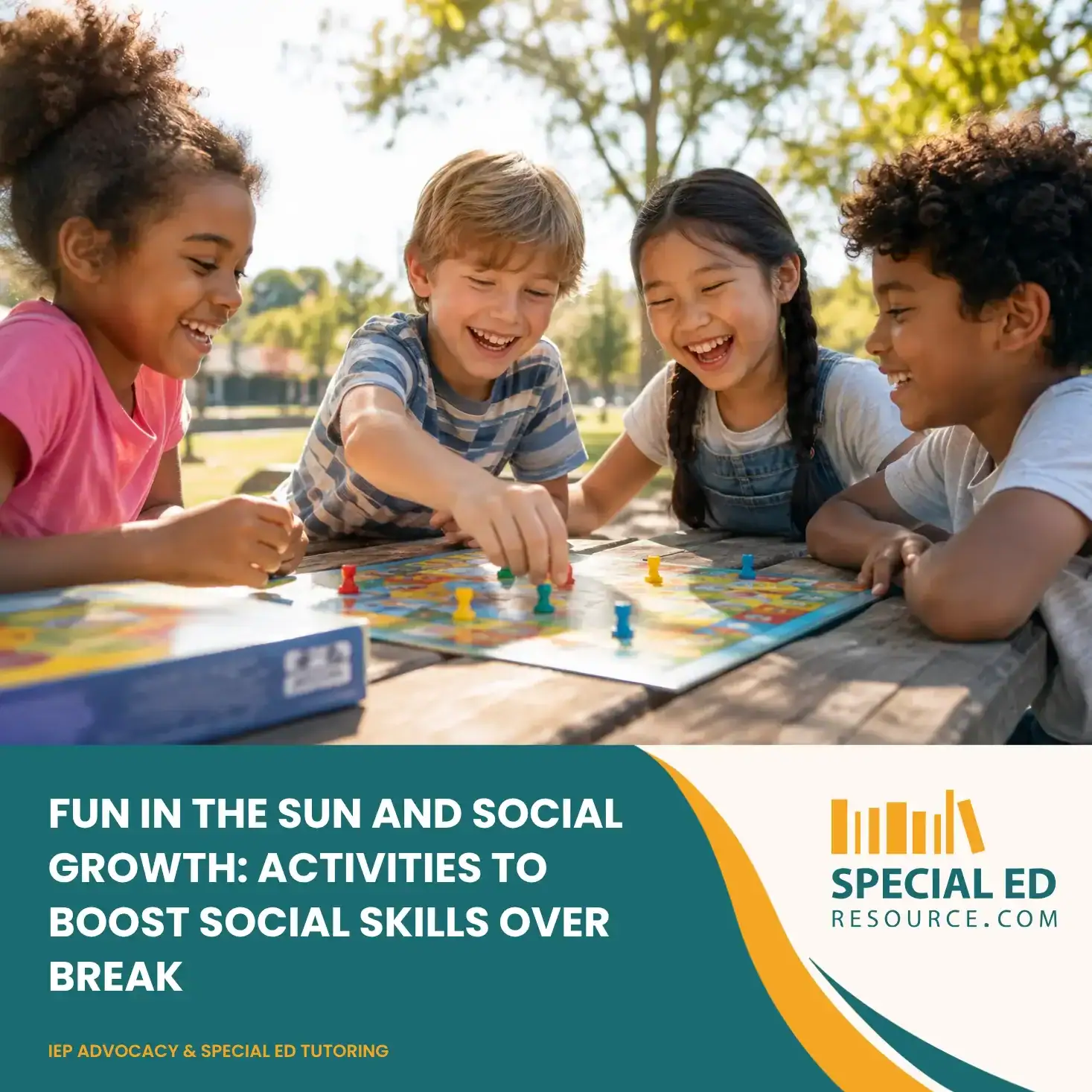
One of the richest environments for social development is a game. Not competitive games designed to produce a single winner at the expense of everyone else, but cooperative games where the group works together toward a shared goal. These games require players to communicate, listen, negotiate, and problem-solve as a team — all core social skills. And because no one is singled out as the loser, the emotional stakes stay low enough for kids who struggle with frustration or rejection to stay in the game.
The market for cooperative and social-skill-building games has grown considerably in recent years, and there are excellent options across every age range and ability level.
For younger children (ages 4–7), Outfoxed is a favorite — players work together to catch a sneaky fox before it escapes, using a process of elimination that naturally teaches turn-taking and group decision-making. Hoot Owl Hoot asks players to cooperate to fly all the owls home before sunrise, with simple enough rules that even very young children can participate fully. Count Your Chickens is another gentle introduction to cooperative play, with bright visuals and zero reading required.
For the middle years (ages 7–12), Forbidden Island and its companion Forbidden Desert are adventure-style games where the whole team wins or loses together — they are genuinely exciting, which keeps engagement high. Pandemic Junior introduces the idea of working as a team to solve a big problem, and it scales well in difficulty. Magic Maze is a surprisingly engaging option for kids who like a challenge: players must move a shared character through a maze without speaking, which builds nonverbal communication and attention to others’ cues in a really concrete way.
For older kids and teens, Codenames is a brilliant vocabulary and communication game that requires players to give and interpret clues — it builds listening skills, flexible thinking, and the ability to see from another person’s perspective. Hanabi, a card game played with hands facing outward so each player can see everyone’s cards except their own, is a wonderful exercise in giving and receiving information clearly and graciously. Just One is a party-style game where everyone writes a one-word clue and duplicate answers are eliminated — it is fast, funny, and creates natural conversation.
Beyond board games, a few other formats are worth considering:
- Improv games like “Yes, And” — where players must accept whatever the previous person said and build on it — teach active listening and flexible thinking in a playful, low-stakes way. No materials needed, just a few minutes and a willingness to be a little silly.
- Collaborative storytelling, whether using a prompt deck like Rory’s Story Cubes or just taking turns adding to a made-up tale, builds perspective-taking, listening, and the ability to read where a conversation is going.
- Scavenger hunts designed for pairs or small teams require communication, negotiation, and shared problem-solving — and they work beautifully as a structured playdate activity.
Some ideas for making cooperative games a summer staple:
- Set a weekly family game night and let the child pick the game at least half the time. Ownership and choice increase engagement.
- After the game, spend five minutes talking about one moment when someone helped the team. This builds vocabulary around cooperation and kindness.
- Introduce “what would you do” scenarios inspired by what happened in the game. If someone got frustrated, what could they have said instead?
- Play with a small mixed-age group when possible — cousins, neighbors, or kids from a homeschool group — to gently expand the social circle.
Community Activities That Build Real-World Social Confidence

There is a difference between practicing social skills in a controlled setting and actually using them in the real world. Both matter. Summer opens up a host of community-based opportunities that put social development in context — places where conversation, cooperation, and navigating the unexpected all happen organically.
Local parks, farmer’s markets, library programs, and community pools are all environments where children encounter peers and adults in ways that feel natural rather than structured. For a child who finds unpredictability stressful, the key is starting small and building exposure gradually.
Consider these options based on a child’s comfort level and interests:
- Library summer reading programs often include group activities, crafts, and performances. These are low-pressure, interest-driven, and staffed by adults trained to be welcoming.
- Community sports leagues, especially those designed for special needs participants, create a framework for peer interaction around a shared activity. The structure of the sport itself reduces social ambiguity.
- Art classes, cooking workshops, or nature programs offered at local recreation centers give children a shared focus that makes conversation easier to start and sustain.
- Volunteer opportunities — even simple ones like helping at a food bank or collecting items for an animal shelter — build empathy, perspective-taking, and a sense of contributing to something larger. These are powerful social skill builders that are often overlooked.
For children on the autism spectrum, connecting with an autism tutor who understands both the academic and social dimensions of development can help set meaningful goals for summer and track progress in a way that informs the fall.
Structured Playdates: Small Settings, Big Growth

For many special needs students, large group settings are overwhelming. The noise, the unpredictability, and the number of social inputs happening at once can make it impossible to focus on actually connecting. A structured one-on-one or small-group playdate can accomplish more in two hours than a birthday party can in five.
The key word is “structured.” A completely unstructured afternoon can drift into parallel play or screen time. But a playdate with a loose plan — a craft to work on, a game to play, a snack to make together — gives both children something to talk about and do. It reduces the pressure to fill silence and creates natural conversation starters.
A few things that help make playdates successful:
- Choose activities that align with the child’s interests. If they love dinosaurs, plan around that. If they are into Minecraft, find a Minecraft-themed craft or activity. Interest-driven play reduces anxiety and increases willingness to engage.
- Keep it short enough to end on a high note. An hour and a half of focused, positive interaction is worth more than three hours of drift and frustration.
- Prepare the child ahead of time. Walk through what the visit will look like, who will be there, what they might do, and how to handle a moment that feels hard. Role-playing a specific scenario — like what to say when you want a turn — builds real-world readiness.
- After the playdate, talk through what went well. Specificity matters: not just “that was fun,” but “I noticed you asked Maya what her favorite part of the game was — that was a great question.” Naming the skill reinforces it.
Everyday Moments as Social Skills Practice

Some of the most powerful social learning does not happen in planned activities at all. It happens at the grocery store, the drive-through, the neighbor’s driveway, or the dinner table. Summer, with its longer and less regimented days, creates more of these moments — and more opportunity to turn them into intentional practice.
A few everyday situations that can become social skills practice with a small shift in framing:
Ordering at a restaurant or counter: Encourage the child to order for themselves rather than having a parent speak for them. Start with low-stakes, familiar settings. Practice at home first by role-playing the interaction. This builds confidence with strangers and teaches how to communicate needs clearly.
Making small talk with neighbors or family friends: Teach and practice a few simple conversation openers — “What are you working on?” or “Did you see the game last night?” These scripts reduce anxiety and give children a reliable way to start a connection.
Navigating conflict with a sibling: Sibling relationships are some of the most complex social dynamics children experience. Rather than resolving every disagreement for them, use the moment to coach. “What do you think she meant when she said that?” and “What could you say to let her know how you feel?” build the kind of reflective thinking that transfers to every other relationship.
Helping in the kitchen or yard: Working alongside another person — measuring, stirring, digging, planting — requires communication, turn-taking, and adjusting to another person’s pace and style. It is social skills practice disguised as chores.
Reading Together to Build Social and Emotional Vocabulary

One of the quieter but deeply effective ways to build social competence is through books. Stories introduce children to characters navigating friendship, conflict, misunderstanding, and belonging. They give children language for emotions and situations they may not yet have words for, and they create a safe distance from which to explore hard topics.
Reading together — not just assigning books, but actually reading aloud and talking about the story — is a rich opportunity. Questions like “why do you think she said that?” or “how do you think he felt when that happened?” develop empathy, perspective-taking, and emotional reasoning. These are the building blocks of social intelligence.
For special needs students who also struggle with reading, audiobooks and graphic novels are equally powerful. The format is less important than the conversation around it.
Some reading themes worth exploring this summer:
- Books featuring characters who are different or who feel like outsiders — these often resonate deeply with special needs kids and open conversations about identity and belonging
- Stories built around friendship and conflict resolution — how two characters work through a misunderstanding or repair a rupture in a relationship
- Narratives that center on cooperation, teamwork, or helping others — these build positive social models and inspire kids to try similar approaches
When More Support Is Needed: Building a Summer Plan That Works

Sometimes activities and intention are not quite enough. Some children need more targeted support to make real progress with social development — a consistent, skilled adult who can assess where the gaps actually are and address them directly. That is not a failure of the family. It is just an honest look at what the child needs.
Special Education Resource works with families across the US and Canada to build individualized support plans that go beyond one-size-fits-all approaches. Whether a student needs help with reading, math, executive function, or the social and emotional skills that make learning possible, the focus is always the same: find the real challenge, dissolve it, and help the child move forward with genuine confidence.
Summer is not the time to push pause. It is the time to get ahead — to build the social skills, the self-belief, and the tools that will make the coming school year look and feel different. With the right activities at home and the right support in place, that is entirely possible. Every child has the capacity to grow. The job is to create the conditions that make that growth happen.